
Bedroom Smells Like Chemicals?
Here's How to Find the Source
That sweet, sharp, or off smell when you walk into your bedroom isn't your imagination. Two DIY checks help identify what's causing it — and why ventilation and humidity often matter just as much as the source itself.
Start Free Assessment (8 Minutes)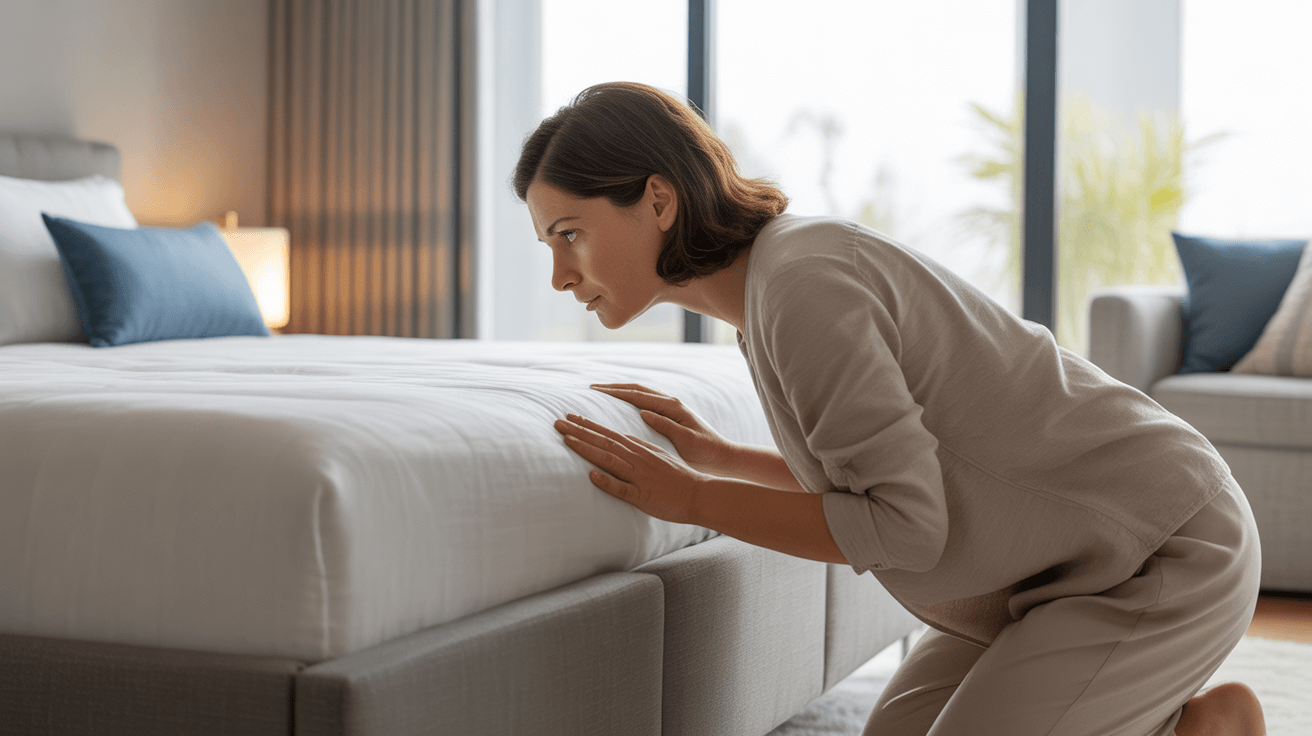
Two DIY Checks to Start With
No equipment needed. These two observations tell you more than most people realize about what's going on and where to look next.
The Morning Smell Test
What to do: Tomorrow morning, before opening any windows or turning on fans, walk into your bedroom from another room and pay attention to the first thing you smell.
Why it works: Bedrooms accumulate whatever is in the air overnight. After 6 to 8 hours with the door closed, any VOC source in the room will have had time to build up to its highest daytime concentration. You'll smell it strongest in those first few seconds before your nose adjusts.
What to notice:
- Is it sweet, sharp, plastic-like, or chemical in a way that's hard to describe?
- Does it fade after you've been standing there a minute? (That's nose fatigue, not the smell going away.)
- Does it seem to come from a direction — the closet, a corner, the bed?
The Close-Range Source Check
What to do: Get close to individual items in your bedroom and breathe in. Mattress, pillow seams, inside dresser drawers, the underside of furniture, area rugs, curtains, closet contents.
Why it works: VOC off-gassing is strongest right at the source. If one item smells noticeably more chemical than the others, that's where to start.
What to notice:
- Does your mattress smell sweet or chemical when pressed against?
- Do dresser drawers or particleboard furniture smell like adhesive?
- Do closet clothes smell different from clothes stored elsewhere in the house?
- Does anything smell like new electronics, nail polish, or fresh paint?
If the smell is strong and accompanied by dizziness, eye irritation, or difficulty breathing: Open windows immediately and get fresh air. Intense chemical odors can indicate high-level off-gassing or something more serious. Don't sleep in the room until it's investigated.
What Your Nose Can and Can't Tell You
You've identified there's a smell. You may have traced it to a source. Here's what the sniff tests alone won't answer — and why this matters before you spend money on a solution.
Many VOCs have no smell at all. Formaldehyde from pressed-wood furniture, certain flame retardants, and some adhesives are odorless or nearly so. If you can smell something, that's a useful signal. But not being able to smell anything doesn't mean there's nothing there — it just means the particular compounds present don't trigger your nose. Relying only on the smell test can give you false reassurance.
Humidity significantly increases VOC off-gassing. Research has found that higher indoor humidity can increase the rate of VOC release by a factor of five or more. If your bedroom has high humidity — above 50 to 55% — a source that might be mildly noticeable in dry air becomes much more pronounced. This is why the same mattress or dresser might smell fine in one home and noticeably chemical in another. Addressing the humidity can reduce the symptom even when removing the source isn't practical right away.
The smell check tells you there's something worth investigating. But whether the solution is removing a source, improving ventilation, reducing humidity, or some combination — that's what the full assessment figures out.
Common Sources in Bedrooms
These are the most frequent sources that produce chemical or off-gassing smells in bedroom environments. They overlap in symptoms but respond to different actions.
🛏️ Mattress and Bedding
Memory foam and polyfoam mattresses off-gas VOCs including formaldehyde, benzene, and toluene from the foam manufacturing process. Off-gassing is highest when new and typically decreases over weeks to months — though it can continue for longer in poorly ventilated rooms. A sweet or chemical smell that's strongest when your face is near the mattress, that started with a new mattress, and that's worse in the morning points here.
🪑 Pressed-Wood and Flat-Pack Furniture
Particle board, MDF, and plywood-based furniture use formaldehyde-based adhesives and resins that off-gas for months to years. Dresser drawers and cabinet interiors often smell strongly because the interior surfaces are enclosed and the air inside gets concentrated. The smell from furniture tends to be sharper than mattress smell — more adhesive, less sweet.
🏠 New Flooring or Carpet
Carpet adhesives, foam underlayment, and synthetic fibers all off-gas VOCs including styrene, 4-PCH (associated with that "new carpet" smell), and formaldehyde. Vinyl and laminate flooring can also release VOCs from adhesives and the PVC or composite materials themselves. A smell that seems to rise from the floor level and is noticed more when you're lying down points to flooring or underlayment.
🪟 Curtains, Treated Fabrics, and Dry Cleaning
Permanent-press and wrinkle-resistant fabric treatments use formaldehyde. Dry-cleaned items off-gas perchloroethylene (PERC) for days after cleaning. Stored dry-cleaned clothes in a closet can fill the bedroom with a chemical smell that's easy to miss because it builds up gradually. A smell that tracks with recently dry-cleaned items or new curtains is worth isolating first.
Why Identifying the Source Is Only Half the Answer

Knowing the source tells you what's producing the VOCs. But how much you're being exposed to depends on three things working together: the strength of the source, how well the room ventilates, and what the humidity level is.
A mattress off-gassing in a well-ventilated room with low humidity may produce no noticeable smell. The same mattress in a sealed, humid bedroom can be quite noticeable. Buying an air purifier might reduce symptoms without addressing the underlying combination. The assessment investigates all three factors, not just whether a source is present.
👃 "Unpleasant or unusual odors"
The assessment works through where the smell is strongest, when it appears, your home's ventilation and humidity patterns, and recent additions to identify what's driving the problem and in what order to address it.
completed
of their air
complete
Select "Unpleasant or unusual odors" to begin
Why EezyAir
Source + Context Together
Removing a mattress might not fix the smell if high humidity or poor ventilation is the real amplifier. The assessment looks at both so the solution actually matches the situation.
Nothing to Sell You
Air purifier companies suggest air purifiers. Mattress companies suggest certified mattresses. We don't sell either. The assessment points toward what your specific situation calls for.
Prioritized Steps
Results come as three categories: no-cost actions, product guidance when warranted, and professional guidance criteria. In that order, so you start with the highest-value steps first.
Optional upgrade: After your free assessment, you can have a U.S.-based analyst review photos of specific areas — the furniture, the room layout, HVAC vents — and confirm your findings before you take action. Under $150. Start free. Upgrade only if you want it.
Find Out What's Actually Going On
8 minutes. Instant results. Free to start.
Begin Free AssessmentSelect "Unpleasant or unusual odors" · No credit card · 1,584 completed