Why Do You Cough or
Feel Off When You Cook?
Throat irritation during frying. Coughing that lingers after you're done. A smoky smell that takes hours to clear even with windows open. Cooking generates fine particles that most kitchen setups don't adequately remove — and your airways notice.
Start Free Assessment (8 Minutes)Does This Sound Familiar?
- You cough or clear your throat while cooking, especially when frying or using high heat
- Smoke or haze lingers in the kitchen long after you've finished
- Your eyes water or throat tightens when cooking certain things
- Asthma or allergy symptoms flare up around cooking time
- The kitchen exhaust fan runs but the air doesn't really clear
- On days you cook a lot, you feel worse in the evenings than on days you don't
😷 "Breathing or allergy symptoms (asthma, congestion, sneezing, coughing)"
The assessment will focus on particle sources, ventilation performance, and combustion patterns that drive cooking-related air quality problems.
What Cooking Actually Does to Your Air
Cooking is one of the most significant sources of fine particle pollution indoors, and most kitchens aren't set up to handle it.
PM2.5 particles — fine particles small enough to bypass your nose's natural filters and reach deep into your lungs — spike dramatically during cooking. High-heat methods, gas stoves, and oils all generate them. Here's what's actually happening.
🍳 High-Heat Cooking and Oil Smoke
Frying, searing, and high-heat roasting produce large quantities of fine particles and combustion byproducts. Oil heated past its smoke point generates particle counts that can exceed outdoor air quality thresholds within minutes, concentrated right where you're standing.
🔥 Gas Stoves and Combustion Byproducts
Gas burners release nitrogen dioxide and fine combustion particles with every use, even before food goes in the pan. Research has consistently linked regular gas stove use to elevated indoor pollutant levels, particularly in kitchens with poor ventilation.
💨 Range Hoods That Recirculate Instead of Vent
Many range hoods, especially in apartments and older homes, filter air and recirculate it rather than exhausting it outside. They reduce visible smoke but don't remove fine particles or combustion gases. The air looks clearer while the particles stay in the room.
🌫️ Particles That Stay Airborne for Hours
Fine cooking particles don't just disappear when you open a window. They can stay suspended in the air for 2 to 4 hours and travel through the home via HVAC circulation. Bedroom air quality in the evening often reflects what happened in the kitchen at dinner.
Why an air purifier alone often doesn't fix it: A purifier in the living room doesn't help much if particles are being generated in the kitchen and your range hood isn't removing them at the source. The assessment maps where particles are generated, where they travel, and whether your ventilation setup is actually doing the job before pointing you toward any product.
Three Quick Checks Right Now
These take under 10 minutes and give the assessment a lot more to work with.
Check #1: The Flashlight Test During Cooking
Next time you cook something with oil or high heat, turn off the kitchen lights and shine a flashlight beam horizontally across the room at eye level. If you can see the beam as a defined line cutting through the air — the way dust looks in a sunbeam — you have elevated fine particle levels. Note how long the beam stays visible after you finish cooking and whether opening windows changes it. If the beam is still visible 30 minutes after cooking ends, your ventilation isn't keeping up.
Check #2: Test Whether Your Range Hood Actually Vents Out
The easy test: Turn on your range hood fan. Hold a lit match or lighter near the hood (not near the burners) and watch the flame. Does it pull noticeably toward the hood? Now check under a cabinet or near the microwave above the stove if that's your setup. Many over-the-range microwaves with built-in fans recirculate air rather than exhaust it outside. Look for a vent on the front or top of the microwave that blows air back into the kitchen — that's a recirculating unit, not an exhaust.
If you have a proper range hood: Find where it exhausts. It should exit through an exterior wall or roof. If you can't find where it goes, or if the duct leads to a cabinet or crawl space, it may not be venting outside at all.
Check #3: Note Where Symptoms Are Worst and When
Pay attention tonight or tomorrow during cooking. Does throat irritation or coughing start before or after food goes in the pan? Does it get worse with specific cooking methods (frying vs. boiling vs. baking)? Do symptoms follow you to other rooms after cooking, or stay concentrated in the kitchen? This timing pattern tells the assessment whether your issue is primarily particle generation at the source, inadequate exhaust at the hood, or particle distribution through the home afterward. Each has a different fix.
If you experience sudden severe breathing difficulty, chest tightness, or symptoms that don't improve after leaving the kitchen: Seek medical attention. Gas stoves can also produce carbon monoxide in poorly maintained or poorly ventilated situations. If you have a CO detector that has alarmed, evacuate and call emergency services before investigating air quality.
What the Assessment Investigates
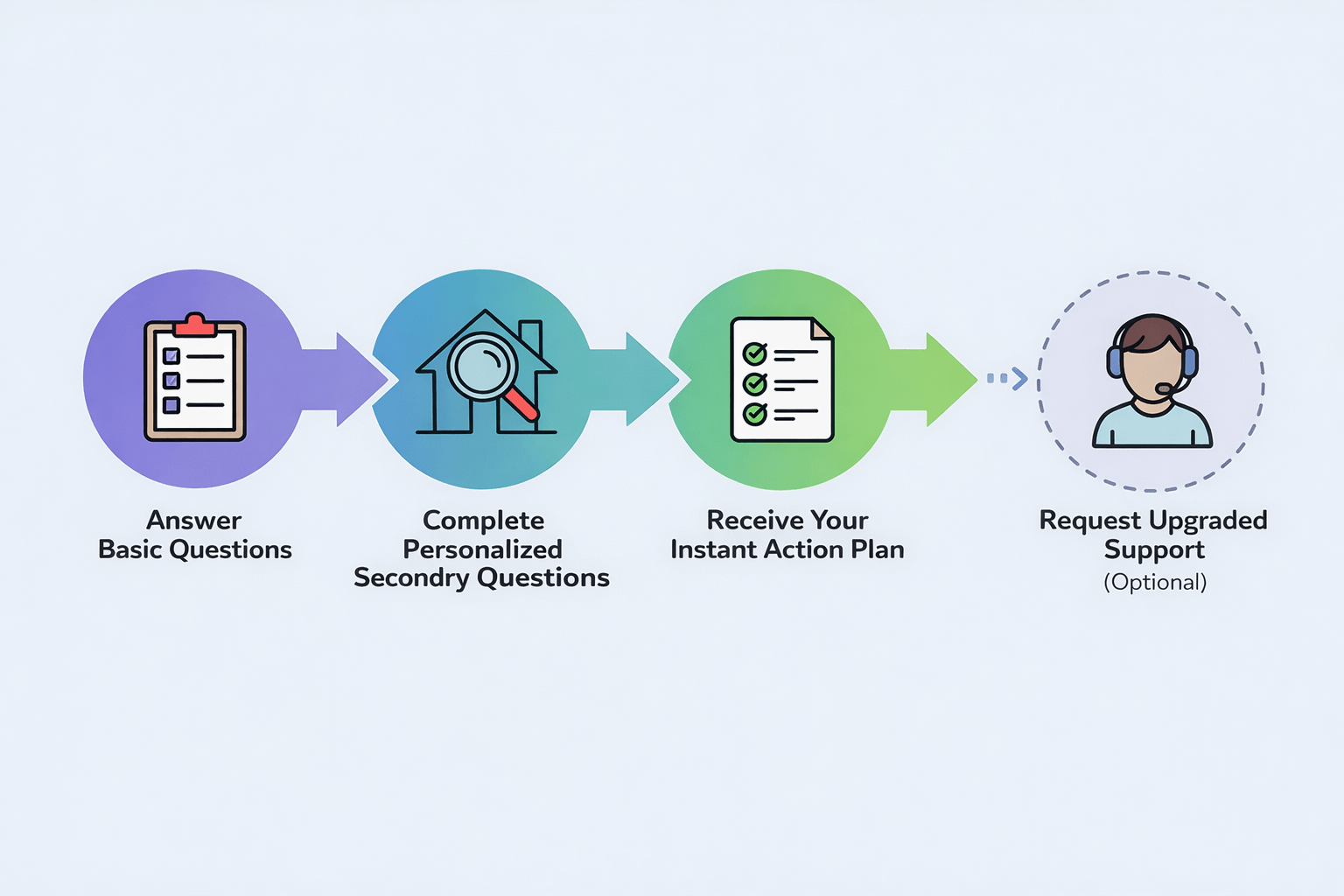
The assessment works through your symptom timing, cooking habits, stove type, range hood setup, ventilation performance, and how air moves through your home. Results are organized when you finish.
You'll get specific direction on what to check, change, or upgrade — and whether your situation warrants a professional HVAC evaluation. Not a generic "get an air purifier" suggestion, but a prioritized plan based on your actual cooking and ventilation setup.
understanding of their air
complete
Select "Breathing or allergy symptoms" when you begin
What You Get From the Assessment
🆓 No-Cost Changes to Try First
Cooking air quality often improves substantially with behavioral changes that cost nothing: adjusting when and how long you run the exhaust, changing cooking temperatures for certain dishes, improving cross-ventilation timing, or modifying how you use the oven vs. stovetop. The assessment tells you which of these apply to your specific setup before recommending anything.
🛒 Targeted Guidance If Products Are Needed
If your assessment points to a specific gap — a recirculating hood that needs to be replaced, a kitchen with no adequate exhaust, or particle distribution through the home — you'll get direction on what type of solution addresses it. Not a generic air purifier recommendation before you know where the particles are going.
👷 When to Bring In a Professional
If patterns point to a range hood that needs to be ducted, gas appliance maintenance concerns, or HVAC issues distributing cooking particles through the home, the assessment tells you clearly so you know what type of contractor or inspection to request.
Optional upgrade: After your free assessment, a U.S.-based analyst can review your specific situation, look at photos of your range hood or kitchen setup, and answer follow-up questions. Under $150. Start free. Upgrade only if you need it.
Why EezyAir
Source First, Solutions Second
We identify whether the problem is particle generation, inadequate exhaust, or whole-home distribution before recommending anything. Most people skip this step and buy solutions that address the wrong part of the chain.
No One Enters Your Home
You do the walk-through and checks yourself. The assessment guides you on what to observe and test so you build an accurate picture of your kitchen and ventilation setup.
No Equipment or Upsell
EezyAir sells information, not hardware. There's no incentive to recommend a $400 air purifier if better range hood technique is what you actually need.
Find Out What's Making You Cough When You Cook
8 minutes. Instant results. Free to start.
Begin Free AssessmentSelect "Breathing or allergy symptoms" to get started · No credit card required