House Still Smells Like
Smoke After a Fire?
When smoke smell persists for days after outdoor air quality improves, it usually means particles are still inside your home — in the HVAC system, embedded in fabrics, or still suspended in the air. Here's how to figure out which one.
Start Free Assessment (8 Minutes)Does This Describe Your Situation?
- Outdoor air quality has improved but the smoke smell inside your home hasn't gone away
- The smell gets noticeably stronger when the heating or AC turns on
- Fabrics — furniture, bedding, curtains — smell more strongly than hard surfaces
- You've aired out the house but the smell comes back when you close up again
- Someone in your home has had persistent coughing, throat irritation, or headaches since the fire
- You're not sure whether your home air is actually safe or just smells like it might not be
👃 "Unpleasant or unusual odors"
The assessment will focus on smoke odor patterns, when and where the smell is strongest, and the HVAC and ventilation factors that determine whether contamination is active or residual.
Why Smoke Smell Persists After Outdoor Air Clears
The smell doesn't mean the danger is over. It also doesn't always mean the danger is continuing. Where the smell is concentrated tells you which.
Fine smoke particles are small enough to penetrate deeply into porous materials and HVAC systems. Once there, they release odor molecules for days or weeks — but not all of them remain a breathing risk. Understanding the difference is what the assessment maps.
🌬️ HVAC Recirculation — Active Risk
If particles entered your HVAC system during the smoke event, every time the system runs it picks them back up from filters, ducts, and coils and redistributes them through the home. Smell that intensifies when heating or AC kicks on is the clearest sign of this. It's an ongoing exposure issue, not just a residual odor.
🛋️ Fabrics and Porous Materials — Embedded
Upholstery, carpet, bedding, curtains, and clothing absorb smoke particles deeply. These materials continue releasing odor compounds for a long time after the air itself has cleared. Strong smell concentrated in soft furnishings is usually embedded contamination — a cleaning issue rather than an ongoing air quality emergency.
💨 Still-Airborne Particles — Clearing
Fine particles can stay suspended for hours to days without settling. Smell that improves significantly and quickly when you ventilate, but returns when you close up again, suggests particles are still in the air rather than primarily in surfaces. Ventilation helps, but may need to be sustained or combined with filtration.
🧹 Resuspension From Cleaning — Avoidable Risk
Dry sweeping, vacuuming without HEPA filtration, or aggressively disturbing fabric surfaces can lift settled particles back into breathing air. People often feel worse after cleaning following a smoke event, not better. Knowing where particles have settled affects how to clean safely.
Smell and health risk don't always align. Your nose detects odor compounds at very low concentrations. Strong smell from a fabric couch may be embedded residue with minimal ongoing breathing risk. Faint smell that gets stronger when the HVAC runs may indicate active particle recirculation that matters more. The pattern — not the intensity — is what tells you which situation you're in.
Three Checks to Run Right Now
These take under 15 minutes and tell you a lot about where the contamination is concentrated.
Check #1: The HVAC Test
Turn your heating or cooling system on if it isn't running. Stand near a supply vent and take a breath. Does the air coming out smell like smoke? Now check whether the smell in the room intensifies over the next 10 to 15 minutes while the system runs, compared to when it's off.
If the smell is noticeably stronger from the vents, or if the room gets smokier while the system operates, particles are in the duct system or on the coils and filters. This is the scenario that most warrants attention because it means contaminated air is being actively delivered to every room the system reaches. A standard filter change won't resolve it — the system needs inspection and likely professional cleaning or filter upgrading.
Check #2: The Fabric vs. Hard Surface Test
Press your face close to your couch or upholstered chairs, then your carpet or rugs, then your curtains or drapes. Compare to a hard surface nearby — a countertop, a wood table, a window frame. Is there a significant difference in smell intensity between soft and hard surfaces?
Strong smell concentrated in fabrics with much less on hard surfaces indicates embedded contamination in porous materials. This is a cleaning challenge, not an ongoing air emergency — but fabric cleaning after smoke exposure requires some care to avoid resuspending particles. Also check items stored in closed spaces like closets and cabinets. If they smell significantly less than exposed items, contamination is primarily surface-level rather than distributed throughout the air.
Check #3: The Ventilation Response Test
Open windows and exterior doors in multiple rooms and create cross-ventilation for 30 minutes. Note how much the smell improves. Then close everything up for a few hours and check again.
If smell improves dramatically with ventilation but returns substantially when you close up, particles are still partially airborne or the HVAC system is reintroducing them. If smell persists at similar levels even with good ventilation, the contamination is primarily embedded in surfaces and materials rather than in the air — ventilation alone won't resolve it, but the active exposure concern is lower. If ventilation makes very little difference either way, the source is likely in the HVAC system or deeply embedded in materials throughout the home.
If the fire was a structure fire on or directly adjacent to your property — not just wildfire smoke infiltration — the contamination picture is more complex. Structure fires leave soot, ash, and chemical residue from burned materials that go beyond fine particle exposure. Professional assessment and remediation are generally appropriate in those situations. The EezyAir assessment is most useful for wildfire smoke infiltration and post-smoke-event evaluation where the structure itself was not directly affected.
What the Assessment Investigates
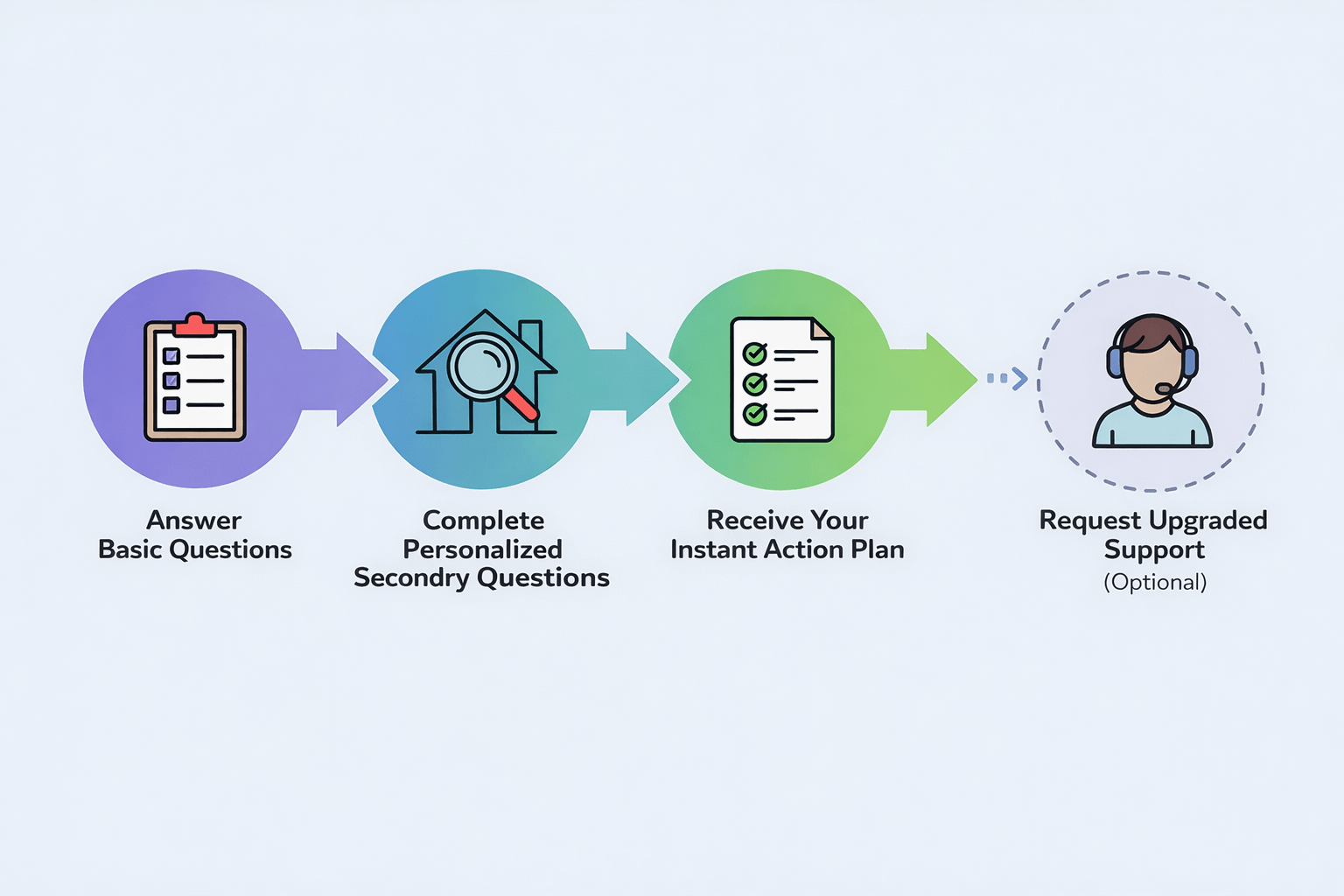
The assessment works through your smoke exposure timeline, odor pattern and location, HVAC behavior, ventilation response, symptom patterns for anyone in the home, and the building characteristics that affect how deeply smoke infiltrated. Results are organized when you finish.
You'll get clear direction on whether the situation calls for HVAC inspection, targeted fabric cleaning, sustained ventilation with filtration, or a combination — matched to your specific exposure pattern rather than generic post-fire advice.
understanding of their air
complete
Select "Unpleasant or unusual odors" when you begin
What You Get From the Assessment
🆓 Immediate No-Cost Steps
Ventilation sequencing, HVAC filter guidance, cleaning approaches that reduce resuspension risk, and how to tell whether the situation is improving over time without buying monitoring equipment.
🛒 Targeted Guidance If Products Are Needed
If your pattern points to ongoing airborne particles or HVAC recirculation, you'll get specific guidance on filtration upgrades or air purifier placement suited to your situation — not generic post-wildfire product recommendations.
👷 When to Bring In a Professional
If the HVAC test points to significant duct contamination, or if symptoms in the home are persistent, the assessment tells you clearly what type of service to request — HVAC cleaning, duct inspection, or professional air quality testing — and what to tell them based on your specific findings.
Optional upgrade: After your free assessment, a U.S.-based analyst can review your specific situation, look at photos of HVAC vents, filters, or affected areas, and answer follow-up questions about your exposure level and next steps. Under $150. Start free. Upgrade only if you need it.
Why EezyAir
Location-Specific Investigation
We distinguish between HVAC recirculation, embedded fabric contamination, and airborne particles — because each requires a different response, and treating the wrong one wastes time and money.
No One Enters Your Home
You do the checks yourself. The assessment guides what to observe so you get an accurate picture of your specific exposure without waiting for a professional appointment.
Calm, Practical Direction
EezyAir gives you an honest assessment of your situation — not worst-case framing designed to sell remediation services, and not false reassurance that ignores real HVAC concerns.
Find Out Where the Smoke Is Coming From
8 minutes. Instant results. Free to start.
Begin Free AssessmentSelect "Unpleasant or unusual odors" to get started · No credit card required